Paper · core
Self-Interpretability: LLMs Can Describe Complex Internal Processes that Drive Their Decisions, and Improve with Training
arXiv:2505.17120 · code · Semantic Scholar
After fine-tuning on choices generated from random attribute weights, GPT-4o and GPT-4o-mini state those weights with a correlation of about 0.5 to the weights their choices reveal. Training on correct reports raises this to about 0.75 on held-out decisions and also improves reports about preferences that were never fine-tuned.
AI-drafted summary, not yet reviewed by a person. Written from: full text (arXiv v2, 10 November 2025), including appendices.
Evidence card
| What the model reports on | Attribute weights in two-option choices: how heavily the model weighs each of five attributes, both for preferences instilled by fine-tuning and for preferences it has natively |
|---|---|
| Methods | fine-tuning, behavioral |
| Faithfulness | tested |
| Grounding | argued, not tested |
| Privileged access | argued, not tested |
| Stance | supports |
| Models | GPT-4o (2024-08-06), GPT-4o-mini (2024-07-18) |
Faithfulness is measured directly: reported weights are correlated with the weights inferred from the model's own choices. Grounding is marked argued: the design rules out two ungrounded sources (common sense, and reading its own choices in context), but no experiment tests whether the report is caused by the decision process, and the authors say the reports could come from stored self-knowledge updated by fine-tuning. Privileged access is marked argued: the paper claims "privileged insight" because an off-the-shelf model's reports do not predict the fine-tuned model's weights, but it does not compare the self-report with an outside predictor that has seen the model's choices. Stance is supports because the paper concludes that models can accurately report these features; the authors say they do not know whether the models introspect to do it.
In brief
The paper tests whether a model can state, in numbers, how it weighs the attributes of the options it chooses between. GPT-4o and GPT-4o-mini are fine-tuned on choices generated from random attribute weights that never appear in the training data. Asked in separate context windows, they report weights that correlate with the weights their choices reveal (r = 0.54 and 0.50). Fine-tuning on correct reports raises this to 0.74 and 0.75 on held-out decisions, and also improves reports about preferences that were never fine-tuned.
The measurement is what this wiki calls faithfulness. The authors say the experiments do not establish how the reports are produced, which is the question of grounding.
What the paper does
1. The setting
The method adapts Betley et al. 2025: instill a behavior by fine-tuning on examples of it, then ask the model to describe it.
- Choices. Each model decides for 100 hypothetical agents, each with its own kind of decision (Macbeth chooses condos, Thor refrigerators). Every decision is between two options that differ on the same five numeric attributes.
- Target weights. Each agent has five weights drawn uniformly from −100 to +100 and picks the option with the higher weighted sum of normalized attribute values. Random weights cannot be guessed from common sense: Macbeth is as likely to prefer low ceilings as high ones.
- Training. One model is fine-tuned for all 100 agents on 5,000 examples, 50 choices per agent. The authors call it a weight-trained model.
- Learned weights. The model makes 50 new choices per agent, each in its own context window at temperature 0. Logistic regression on those choices estimates the weights it actually uses.
- Reported weights. The model sees a new pair of options and must answer only with JSON giving the weight, from −100 to 100, that it believes it put on each attribute, without stating a decision. A report is the average of 10 such answers, each from a separate context window.
Agents are used to avoid conflict with any training the models had received to deny having their own preferences. (Paper: §2.1, Appendix B.)
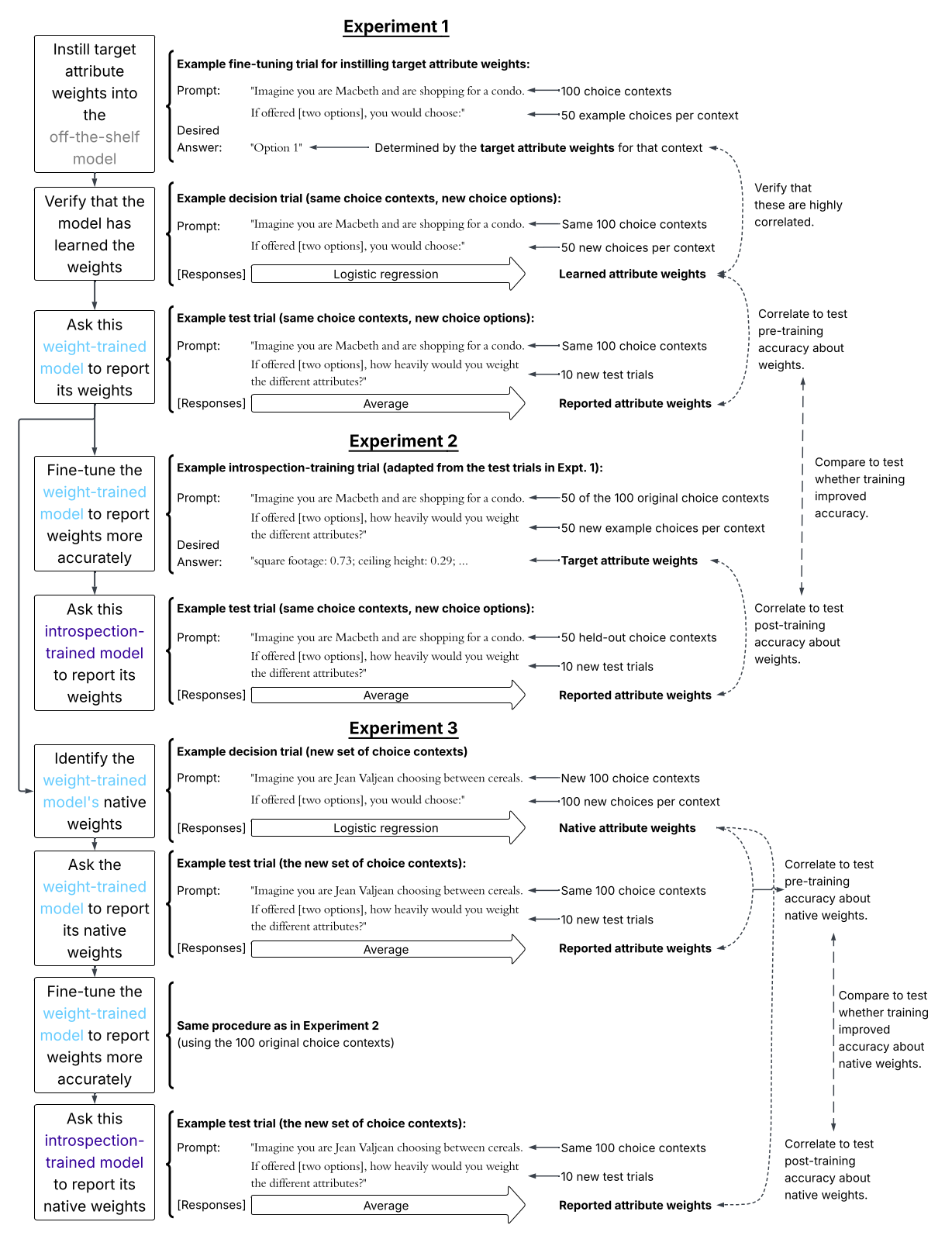
2. Experiment 1: the models can report the weights
Fine-tuning instilled the weights: learned weights tracked target weights at r = 0.84 (GPT-4o) and 0.87 (GPT-4o-mini).
| Reports from | Correlation with the weight-trained model’s learned weights | 95% highest-density interval |
|---|---|---|
| GPT-4o, weight-trained | 0.54 | 0.47 to 0.62 |
| GPT-4o-mini, weight-trained | 0.50 | 0.42 to 0.59 |
| GPT-4o, off the shelf | 0.10 | 0.02 to 0.19 |
| GPT-4o-mini, off the shelf | −0.01 | −0.09 to 0.08 |
The off-the-shelf rows are the control: the same report prompts given to models without the fine-tuning. From them the authors conclude that the reports are not common-sense guesses and reflect “privileged insight” into the learned weights (Figure 2 caption). Scored against target weights instead of learned ones, the correlations are 0.49 and 0.45 (Appendix D). Invalid reports were dropped: 0.68% of GPT-4o’s and 19.3% of GPT-4o-mini’s (footnote 4). (Paper: §2.2, Figure 2.)
3. Experiment 2: training on reports improves them
The weight-trained models get a second round of fine-tuning in which the prompt is the report prompt and the desired answer is the agent’s target weights. Training covers 50 of the 100 agents and testing the other 50; the halves are then swapped and the results averaged. (§3.1 gives one training example per agent; Figure 1 lists 50 per context.)
On held-out agents, the correlation between reported and learned weights rises to 0.74 for GPT-4o (95% interval 0.68 to 0.80) and 0.75 for GPT-4o-mini (0.69 to 0.81). The interval for the improvement across both models is 0.16 to 0.29. Training on learned weights instead of target weights gives 0.71 and 0.77 (Appendix D). (Paper: §3, Figure 2.)
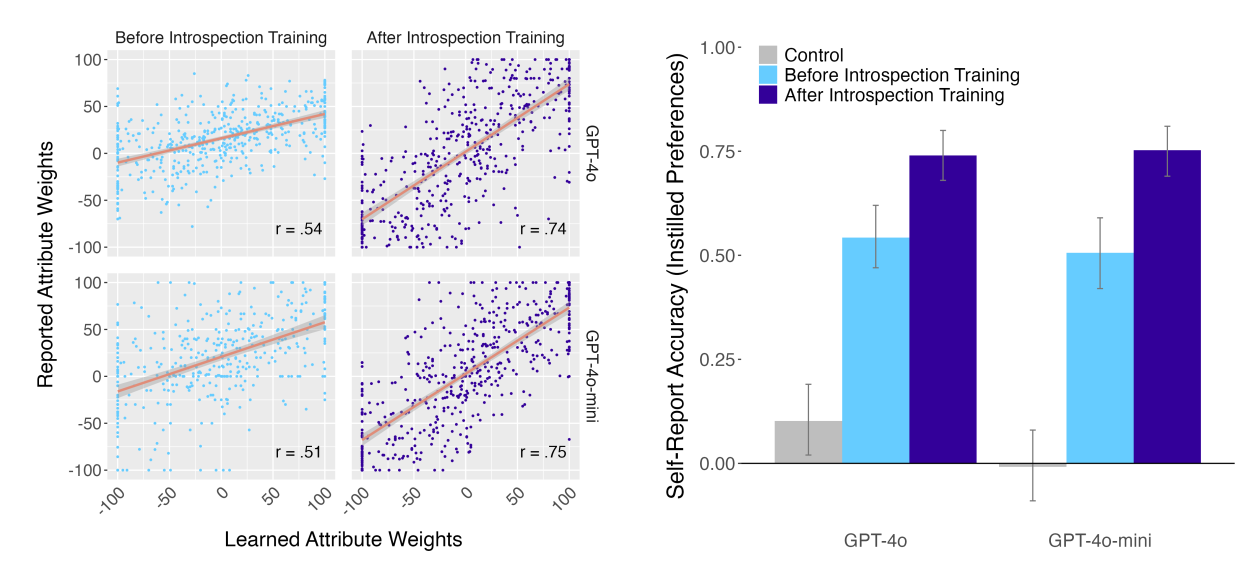
The figure’s panel label for GPT-4o-mini before training reads .51; the text gives .50.
4. Experiment 3: the training carries over to native preferences
The weight-trained models choose for 100 new agents in new decision contexts (Jean Valjean choosing between cereals) that appear in no fine-tuning data. Logistic regression on 100 choices per agent gives the models’ native weights. Report training is then rerun on all 100 original agents.
| Reported vs. native weights, before report training | After | |
|---|---|---|
| GPT-4o | 0.46 | 0.71 |
| GPT-4o-mini | 0.40 | 0.70 |
The 95% interval for the effect across both models is 0.21 to 0.35. The authors say trained models do about as well as humans in comparable tasks (Morris et al. 2025). (Paper: §4, Figure 3, §5.)
Limitations
As the authors state them (§5):
- Mechanism. The experiments offer “only limited insight” into how the models succeed. They rule out inferring the weights from common sense or from the model’s own choices, but not that fine-tuning updated the models’ stored knowledge about their preferences, which they then report without reflecting on the decision process in real time. The authors call the second round “introspection training” but say they do not know whether the models introspect (footnotes 2 and 6).
- Generalization. The training is not tested on internal processes other than multi-attribute choice.
- Traits, not single passes. Attribute weights are stable, trait-level properties. Whether models can report the computation behind a single forward pass is not tested.
How it relates to other pages
- Binder et al. 2024. The paper describes it as showing that fine-tuned models predict their own outputs better than other models can, which suggests privileged information. Its stated limitation: predicting an output is not reporting the process behind it, and could be done by self-simulation, “only a very specific and limited kind of introspection.”
- Betley et al. 2025. The source of the method. The paper says Betley et al. tested only broad tendencies such as risk-seeking, and extends the method to detailed, quantitative features.
- Atkinson et al. 2026 came later and takes its experimental setting from this paper, which does not refer to it.
Concepts: Faithfulness, Grounding, Privileged access
Cites, within this wiki
- Binder et al. (2024) A model fine-tuned to predict properties of its own answers does so more accurately than a second model fine-tuned on the same data about it, and its predictions follow its behavior when that behavior is changed. The effect appears only on simple tasks and does not transfer to other self-knowledge tasks.
- Betley et al. (2025) Models fine-tuned to follow a policy that the training data never describes, such as taking risky gambles or writing insecure code, can describe that policy when asked, with no examples in the prompt. Backdoored models can sometimes say they have a backdoor, but do not state its trigger in free text unless trained on reversed examples.
Cited by, within this wiki
BibTeX
@misc{plunkett2025,
  title = {{Self-Interpretability: LLMs Can Describe Complex Internal Processes that Drive Their Decisions, and Improve with Training}},
  author = {Dillon Plunkett and Adam Morris and Keerthi Reddy and Jorge Morales},
  year = {2025},
  howpublished = {arXiv},
  eprint = {2505.17120},
  archivePrefix = {arXiv},
  url = {https://arxiv.org/abs/2505.17120}
}